
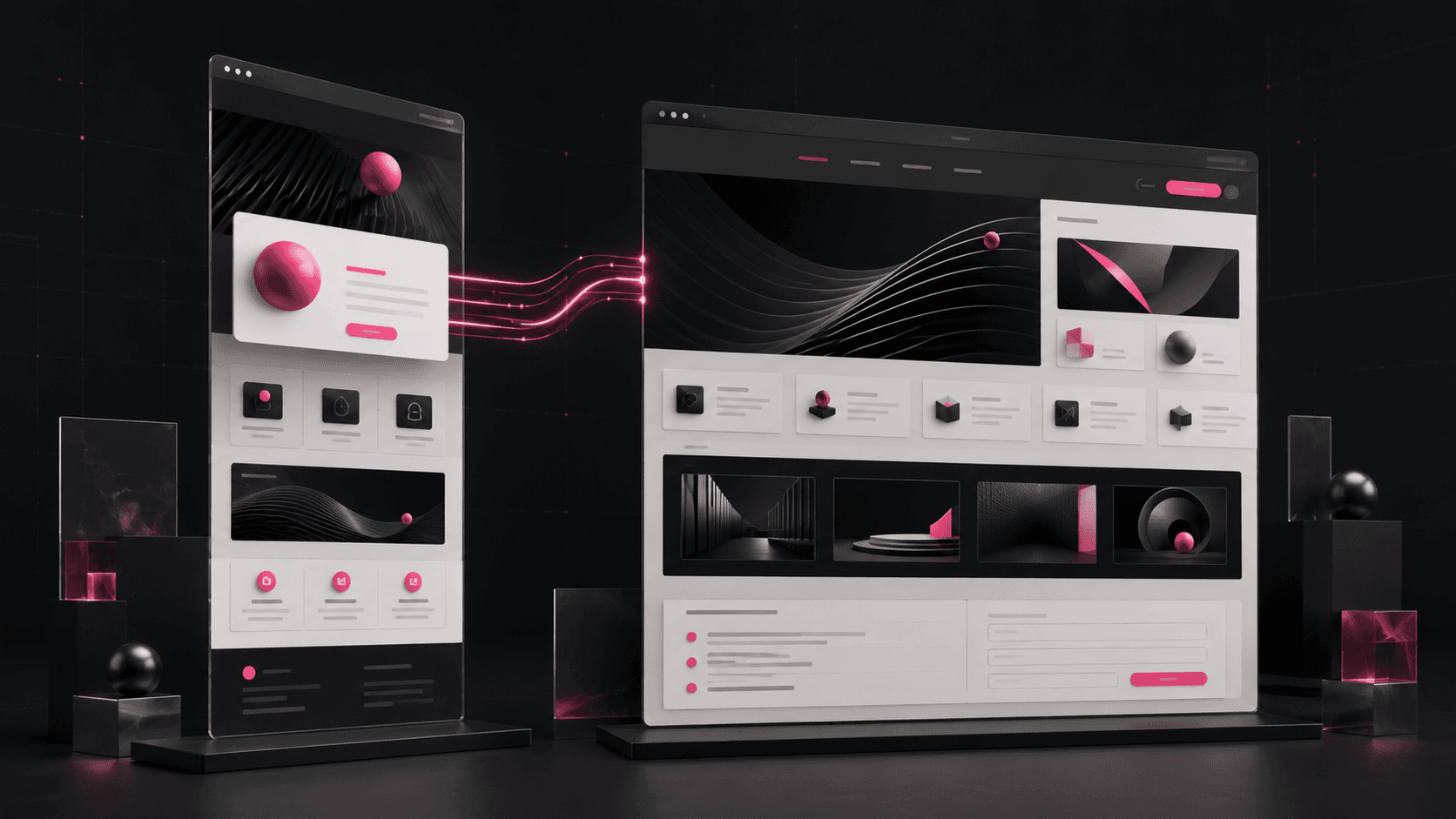
Landing Page vs Website: Which Is Right for Your Business?
Many businesses ask for a “simple website” when what they really need is a focused landing page.
Others request a landing page because it sounds faster or more affordable, even though their customers need to explore several services, review previous work, and learn more about the business before making contact.
The terms are often used interchangeably, but landing pages and full websites serve different purposes.
A landing page guides one audience toward one specific action. A full website gives visitors a broader understanding of your business and supports multiple customer journeys.
The right choice depends less on the number of pages and more on what your visitors need before they feel ready to act.
The Quick Answer
Choose a landing page when:
- You have one clear offer.
- You are targeting one specific audience.
- You want visitors to complete one primary action.
- Most traffic will come from advertising, email, social media, or a QR code.
- You are launching or testing a campaign.
Choose a full website when:
- You offer several services or products.
- Visitors need to learn more about your business.
- Customers want to see your work, experience, or credentials.
- Organic search is part of your long-term growth strategy.
- You expect the platform to grow over time.
Choose both when your website is the main digital home of your business and you need focused landing pages for specific campaigns, services, events, or offers.
What Is a Landing Page?
A landing page is a focused web page created around one offer, campaign, or objective.
Its purpose is to guide visitors toward one clearly defined action.
That action might be to:
- Request a quote.
- Book a consultation.
- Register for an event.
- Download a guide.
- Join a waitlist.
- Purchase one product.
- Claim a limited offer.
- Submit an enquiry.
Strong landing pages remove unnecessary distractions.
The headline matches the campaign that brought the visitor to the page. The content explains the offer, presents its benefits, addresses common concerns, and guides the visitor toward the call to action.
A landing page is not simply a short website. Its defining feature is focus.
Every section should support the same conversion goal.
What Is a Business Website?
A business website is the main digital home of a company.
It helps visitors understand:
- Who the business is.
- What products or services it provides.
- Who it serves.
- Why it can be trusted.
- What makes it different.
- How customers can take the next step.
A typical business website may include:
- A homepage.
- An about page.
- Individual service pages.
- Projects or case studies.
- Testimonials.
- A blog or resource section.
- Frequently asked questions.
- A contact or booking page.
Not every visitor is ready to enquire immediately.
Some people want to compare services. Others want to see previous projects, understand the process, check the company’s credibility, or return later.
A full website supports these different needs without forcing every visitor through the same journey.
Landing Page vs Website: The Key Differences
1. One Goal vs Multiple Business Goals
A landing page works best when success can be measured through one action.
For example, a company running an advertisement for a free consultation can send visitors to a landing page built specifically around that consultation.
The message, benefits, proof, and call to action all support the same offer.
A full website has a broader role. It may need to:
- Attract search traffic.
- Explain several services.
- Build trust.
- Present previous work.
- Answer customer questions.
- Support existing clients.
- Generate enquiries.
If you cannot identify one primary action for the page, you may be trying to fit a website-sized problem into a landing page.
2. A Controlled Journey vs an Exploratory Journey
A landing page creates a controlled sequence.
The visitor usually moves through:
- A clear headline.
- A description of the problem.
- The proposed solution.
- Benefits of the offer.
- Supporting proof.
- Frequently asked questions.
- A final call to action.
A full website allows visitors to explore.
Someone might move from the homepage to a service page, open a case study, read an article, and then submit an enquiry.
This journey is less linear, but it is often necessary for services that require more trust and consideration.
Neither approach is automatically better. The right journey depends on how much information a customer needs before making a decision.
3. One Audience vs Multiple Visitor Types
A landing page usually targets one defined audience.
For example, a property company might create a landing page for overseas investors interested in one development.
The content can focus entirely on that audience’s goals, concerns, and preferred next step.
A full website may need to support several visitor types.
A property website might serve:
- Buyers.
- Investors.
- Sellers.
- Landlords.
- Tenants.
- Property owners.
Each audience may require different information and a different path through the website.
4. Focused SEO vs Broader Search Visibility
A useful landing page can appear in search results when it answers a specific search intent well.
However, one page has limited space to cover several different topics without becoming unfocused.
A full website can create a dedicated page for each meaningful service, topic, location, or customer question.
For example, a creative studio could create separate pages for:
- Website design.
- Web development.
- Brand identity.
- Landing page design.
- E-commerce development.
- Digital solutions.
Each page can answer a different search intent and provide visitors with a more relevant destination.
More pages alone do not improve SEO. Every page still needs a clear purpose and genuinely useful content.
Google recommends creating helpful, reliable, people-first content and using words people search for in prominent areas such as page titles, headings, links, and image descriptions.
You can review the official Google Search Essentials for more information.
If long-term organic visibility is important to your business, a structured website usually provides more room to build it properly.
5. Immediate Conversion vs Wider Credibility
A landing page builds confidence around one offer.
It may include:
- A clear value proposition.
- Benefits of the offer.
- Testimonials.
- Results or case studies.
- A simple process.
- Frequently asked questions.
- A strong call to action.
A full website builds confidence in the entire business.
Visitors can evaluate:
- The quality of the brand.
- The company’s experience.
- The depth of its services.
- Previous projects.
- Client testimonials.
- The professionalism of the overall presentation.
This is especially important when the purchase is expensive, complex, or dependent on trust.
A potential client choosing a clinic, property adviser, creative partner, or technical service provider may want to explore more than one page before making contact.
6. A Defined Campaign vs Long-Term Growth
A landing page is ideal for a focused campaign, launch, or temporary offer.
It can be faster to plan because the audience, message, and conversion goal are clearly defined.
A full website requires more planning.
The project may involve:
- Information architecture.
- User journeys.
- Content planning.
- Brand consistency.
- Technical SEO.
- Responsive design.
- Performance optimization.
- Future integrations.
The initial scope is larger, but the website can support the business for much longer.
Choosing only based on the lowest initial cost may create additional work later.
If a one-page build quickly needs several service pages, projects, articles, integrations, and campaign pages, rebuilding the structure may cost more than planning the correct foundation from the beginning.
7. Performance Depends on Execution
A landing page is not automatically fast, and a full website is not automatically slow.
Performance depends on factors such as:
- Image sizes.
- Video usage.
- Fonts.
- Animations.
- Third-party scripts.
- Hosting.
- Code quality.
- Mobile optimization.
Google’s Core Web Vitals assess user experience through loading performance, responsiveness, and visual stability.
You can review the official Web Vitals guidance for more information.
Whether you choose a landing page or a full website, it should be:
- Mobile-first.
- Responsive.
- Accessible.
- Optimized for performance.
- Tested on real devices.
When a Landing Page Is the Better Choice
A landing page is usually the right choice when:
- You are running advertisements for one specific service or offer.
- You are launching a product, event, webinar, or waitlist.
- You want to test demand before investing in a larger platform.
- You need a focused destination for an email campaign.
- You are promoting an offer through social media.
- You have one clear audience and one clear conversion goal.
- Your existing website needs a campaign page without changing its main structure.
For example, a clinic could use a landing page for one seasonal treatment campaign, even if its main website explains all its services.
A property company could create a landing page for one development while keeping broader company and listing information on its full website.
A creative studio could use a landing page to promote a limited website package while keeping its portfolio, services, and company information on its main website.
When a Full Website Is the Better Choice
A full website is usually the right choice when:
- You offer several services or products.
- Different visitor types need different information.
- Customers research carefully before contacting you.
- You need to display previous work or case studies.
- You want to publish articles, guides, or resources.
- Organic search is part of your long-term strategy.
- You need booking, e-commerce, member access, or other integrations.
- Your brand needs a credible digital home.
- You expect the website to grow with the business.
For most established service businesses, a website is not only a sales tool. It is also a credibility check.
A prospective client may discover the company through Instagram, Google, an advertisement, or a referral, then visit the website to decide whether the business feels trustworthy.
Why Many Businesses Need Both
A website and a landing page are not competing products. They can work together.
The main website provides the foundation for the brand.
It may include:
- The company story.
- Services.
- Work or case studies.
- Testimonials.
- Educational content.
- Contact information.
Landing pages can then support individual campaigns.
Each landing page can focus on:
- One audience.
- One offer.
- One message.
- One conversion goal.
This gives campaign visitors a focused experience while still allowing them to check the wider company when they need more reassurance.
It also makes campaign measurement easier.
Traffic from a specific advertisement can be sent to a dedicated landing page with its own form, button, or tracking event.
This helps the business understand which campaign, message, and offer generated the response.
Common Mistakes to Avoid
Sending Every Advertisement to the Homepage
A homepage usually contains several messages and navigation options.
If someone clicks an advertisement for one specific offer, sending them to a focused landing page creates a clearer connection between the advertisement and the next step.
Treating a Landing Page as an Easy Project
The phrase “just one page” can be misleading.
A high-performing landing page still requires:
- Strategy.
- Copywriting.
- Design.
- Responsive development.
- Conversion planning.
- Analytics.
- Testing.
A page may be short, but it still needs to guide visitors toward a decision.
Building Too Many Unnecessary Website Pages
A full website does not need dozens of pages to be effective.
A smaller, well-structured website can perform better than a large website filled with repetitive or unhelpful content.
Every page should have a clear purpose.
Choosing Only Based on Price
The cheapest option is not always the most cost-effective option.
A landing page may be enough for a short campaign, but it may create limitations if the business already needs several services, search visibility, case studies, and future integrations.
Choose based on what the business needs to achieve, not only on the number of pages.
Five Questions to Help You Decide
1. What Is the Main Action You Want Visitors to Take?
If there is one clear answer, a landing page may be enough.
If the answer changes depending on the visitor, a full website is more suitable.
2. How Will People Find You?
Paid advertisements, email campaigns, and social media promotions often benefit from a focused landing page.
Search traffic, referrals, and direct brand research usually require a broader website experience.
3. How Much Proof Does the Customer Need?
Consider whether visitors need:
- Case studies.
- Team information.
- Service explanations.
- Testimonials.
- Frequently asked questions.
- Educational content.
The more information customers need before making contact, the more likely you are to need a full website.
4. Will the Content Grow Over the Next Year?
If you expect to add services, locations, projects, articles, products, or integrations, plan a scalable website structure from the beginning.
5. Are You Testing an Idea or Building a Permanent Brand Asset?
A landing page can be an effective way to test a new idea or offer.
A full website is a stronger foundation when the business model and services are already established.
The Better Question to Ask
The better question is not:
How many pages do I need?
The better question is:
What does my customer need to see before taking the next step?
Answering that question makes it easier to choose the right structure, content, and conversion path.
How MM Creative Studio Approaches the Decision
At MM Creative Studio, we start with the job the website needs to do.
We consider:
- The offer.
- The target audience.
- The traffic source.
- The customer’s questions.
- The desired action.
- The plans for future growth.
Sometimes the right answer is one focused landing page.
Sometimes it is a complete custom website.
Often, it is a strong website supported by campaign-specific landing pages.
The goal is not to make the project bigger than necessary. It is to build the right digital experience for the business now without creating avoidable limitations later.
Final Thoughts
A landing page is best for focus.
A full website is best for depth, credibility, and long-term growth.
The right choice depends on the decision your visitor needs to make and the amount of information they need to make it confidently.
If you are unsure which format suits your business, send us your offer, audience, and main goal.
We will help you identify whether you need a landing page, a full website, or a combination of both.
Start a Project With MM Creative Studio
Frequently Asked Questions
Can a Landing Page Replace a Website?
A landing page can temporarily replace a website when a new business is validating one offer or collecting early interest.
It is less suitable when customers need to explore several services, assess the company’s broader credibility, or find the business through different search topics.
Can a Landing Page Rank on Google?
Yes. A useful and technically accessible landing page can rank for a relevant search.
However, one page usually has less room to cover multiple search intents than a structured website with dedicated pages.
Which Converts Better, a Landing Page or a Website?
A focused landing page often works better for a specific campaign because its message and call to action match the advertisement or offer.
A full website may convert better when visitors need more information and trust before making contact.
Conversion depends on the audience, offer, traffic source, and quality of execution.
Is a One-Page Website the Same as a Landing Page?
Not always.
A one-page website may include the complete story of a business, several services, an about section, projects, and contact information.
A landing page is built around one audience, one offer, and one primary action.
Should a New Business Start With a Landing Page?
A landing page can be a smart starting point when the business is testing a specific idea.
If the company already offers several services and needs a professional brand presence, a small but scalable website is usually the stronger foundation.
Can I Add Landing Pages to an Existing Website?
Yes. This is often the best setup.
The website supports the overall brand while each landing page gives a specific campaign a focused message and conversion path.